Tutorial: An overview of 3D Vision-Language Models
*: Equal contribution
†: Corresponding Author
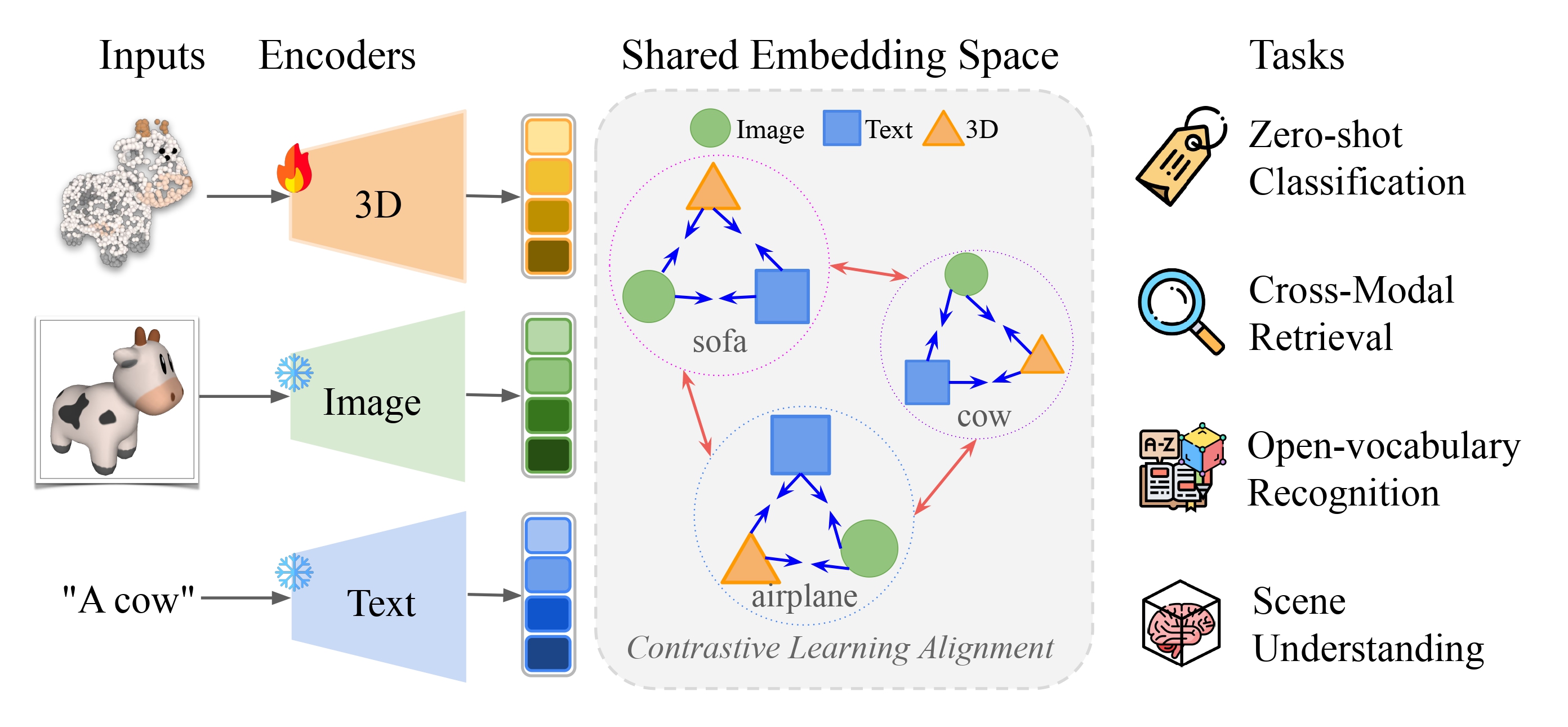
Vision-Language Models (VLMs) are reshaping computer vision by aligning visual and textual embeddings, allowing models to recognize visual concepts and reason about them using natural language. Traditional 3D deep-learning models, however, are typically trained for specific tasks, such as classification, segmentation, or detection, and do not naturally support cross-modal retrieval from their embedding spaces using text or images as queries. To address this issue, Contrastive Language-Image Pretraining (CLIP)-based methods align 3D embeddings with pretrained image and text representations, giving rise to 3D Vision-Language Models (3D VLMs) that support zero-shot classification and cross-modal retrieval, and open-vocabulary recognition of 3D shapes. This tutorial provides an overview of 3D VLMs, ranging from basic definitions of 3D representations and their encoding into embeddings to cross-modal contrastive alignment, modern multimodal frameworks, and 3D Vision-Large Language Models (3D VLLMs). We present the main definitions of contrastive learning for multimodal embedding alignment and highlight recent advances in language-guided 3D Gaussian splatting, 3D shape generation, and embodied AI for robotics.
If you find our work useful, please consider citing our paper.
                            @misc{...,
                            }
This work was supported in part by the São Paulo Research Foundation (FAPESP), under grants #2024/09462-1 and #2026/01721-3, and by the Conselho Nacional de Desenvolvimento Científico e Tecnológico (CNPq) under fellowship grant #315158/2023-9.